How to Be a
Fucking Human
One human’s attempt to figure out what the hell is going on.
NO GURU DETECTED ✦ still taking the fucking course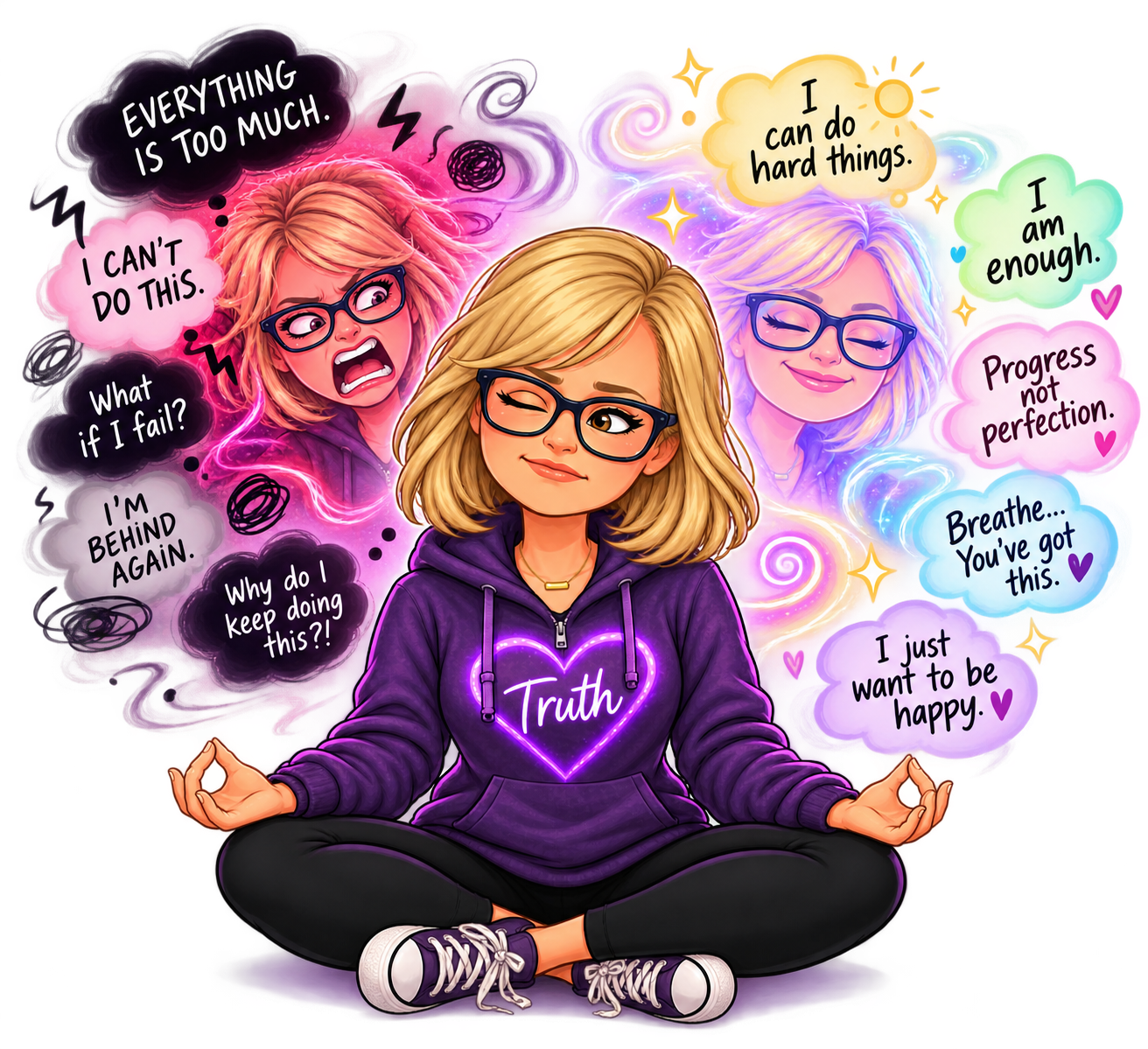
Mental health was where I started asking the questions.
Being human is where the questions led me.
Before the book. Before the Lab. I was trying to understand my own mental health—and stop being ashamed of talking about it.
First, I was trying to understand me.
What was happening inside my own head? Why did I feel the way I felt? Why couldn't I just make myself be okay?
I got tired of hiding mental health.
I was tired of pretending I was fine, tired of the shame, and tired of acting like talking about mental health was something to whisper about.
So I started paying attention.
I tracked moods, patterns and what actually helped. I tried the advice. I kept what worked. I questioned what didn't.
The questions got bigger.
Mental health connected to grief, relationships, identity, my body, my environment—and eventually the much bigger question of how the fuck to be a human.
What the hell is that?
The book starts with ordinary questions that turn out to have entire fucking ecosystems underneath them.
So we investigate.
Not because I have humanity solved. Because I spent a ridiculous amount of my life thinking I was uniquely bad at it. The book starts with your story, asks better questions, looks closer, and tries shit in real life.
The Original
Laboratory.
This didn't start as a website. It started in my bedroom, with a tiny desk, too many questions, and me trying to figure out my own fucking life.
I didn't set out to build a Lab.
I was trying to heal. I had been told what I should do, what should work, and what getting better was supposed to look like.
Except some of it didn't work for me. Other things helped that weren't supposed to. So I started paying attention.
There was a very tiny desk.
For my first year working from home during COVID, that little wooden desk was barely wider than my chair—and somehow I had two monitors crammed onto it.
It was also Cameron's first year gone and Kari's first year of life. Work, grief, love, school, survival and regular everyday shit were all happening in the same room.
Eventually I needed more room. So I built a bigger desk. Turns out that part was going to become a theme.
I wrote things down. Tracked moods. Tried routines. Changed my environment. Made things. Rested. Questioned old beliefs. Watched my patterns. Tried the advice. Kept what helped. Questioned what didn't.
The room became
the Lab.
Not a polished wellness studio. My actual life. Every card is a receipt. Every receipt has another side.
Story
The visible receipt—the photo, video, object, room or moment that opens this story.
This space is for Jill’s actual words from that point in the story.
This space holds what became clear later—without rewriting what the moment felt like then.
So I became the example I needed.
I couldn't find somebody living this in a way I could point to and say, there. That's what this looks like.
So I took “do as I say, not as I do” out of my vocabulary. If I wanted something different for my kids and grandkids, they needed to be able to see me practice it too.
I realized I wasn't only missing information. I was missing support.
The book became a place to tell the story—what I lived, what I learned, what I tried, what changed, and the questions I still have. But I also wanted the thing I couldn't find when I needed it: somewhere to actually practice this shit with other humans.
The Book
My story, the lessons, the receipts, and the questions underneath them.
Workbooks + Tools
Ways to investigate your own patterns instead of copying mine.
The Lab Website
An interactive place to notice, question, experiment, observe and adjust.
Community + Support
Other humans doing the same messy human shit—with more support as it is actually built.
How’s your human doing today?
No clinical intake form. No gold stars. Tap the one currently driving the meat suit.
Buffering...
I walked into the room and forgot the entire plot.
Pre-living disasters
My brain made a PowerPoint about everything that could go wrong.
People’d out
I love humans. From over there.
I KNOW BETTER
...and yet here we fucking are.
Feeling all of it
Love, grief, anger, relief. Apparently they can carpool.
Observing the specimen
Wait. I do that every time, don’t I?
Human Status Report
Choose whatever fits. There are no points. There will be no permanent record. Your mother will not be notified.
Things humans do instead of addressing the actual problem.
The joke works because there’s usually a real human thing underneath it: avoidance, hope, overwhelm, shame, dopamine, exhaustion, wanting control, wanting relief, or simply being a person with access to one-click shipping.
A human being is where all the subjects collide.
No single explanation gets to own the whole person. The book zooms in and out — body, brain, development, family, relationships, culture, history, beliefs, loss, resources, choices, and all the unpredictable shit nobody controls. Flip each card to see how that lens can show up in your life and mental health.
Sleep, stress, pain, hormones, attention, nervous system, physical state.
HOW IT HITS YOUR LIFE ↻Sleep, stress, pain, hormones, attention and your nervous system can change your energy, focus, patience and emotional intensity. Sometimes what feels like a personal failure is a body asking for care or capacity.
↻ BACKBeliefs, emotions, learning, memory, coping, patterns, meaning.
HOW IT HITS YOUR LIFE ↻Beliefs, emotions, memory and coping shape what you notice, expect and do next. Old learning can keep a pattern running long after the situation that taught it has changed.
↻ BACKAttachment, roles, love, conflict, communication, boundaries, repair.
HOW IT HITS YOUR LIFE ↻The people around you can affect safety, belonging, trust, self-worth and stress. Support can soften hard seasons; conflict, instability or isolation can pile more weight onto them.
↻ BACKNorms, expectations, identity, power, institutions, what “normal” was supposed to mean.
HOW IT HITS YOUR LIFE ↻The rules around you help define what feels normal, shameful, possible or allowed. Expectations, institutions, discrimination and access to resources can all change the amount of stress a human is carrying.
↻ BACKThe world you developed inside — technology, events, values, opportunities, pressure.
HOW IT HITS YOUR LIFE ↻The world you grew up in helped shape your expectations, coping skills and idea of normal. Technology, economics, major events and generational norms can leave fingerprints on how you move through life.
↻ BACKGrief, trauma, change, adaptation, the price of getting through what happened.
HOW IT HITS YOUR LIFE ↻Grief, trauma and major change can affect sleep, attention, trust, energy and how quickly your alarm system fires. Survival strategies can keep protecting you even after the original danger is gone.
↻ BACKThe stories you inherited, built, protected, questioned, or outgrew.
HOW IT HITS YOUR LIFE ↻The stories you hold about yourself and the world can influence hope, shame, attention, avoidance and persistence. Meaning can help organize what happened — but an old rule can also keep you stuck.
↻ BACKWhat becomes possible once you can actually see what’s happening.
HOW IT HITS YOUR LIFE ↻What you do repeatedly can create new skills, boundaries and evidence. Small choices matter, but choice is never just willpower — safety, capacity, disability, money, support and circumstances matter too.
↻ BACKThe book is the book.
The world keeps going.
You can read it, close it, and be done. Or when something hits home, there can be another door waiting—not because you have to go through it, but because sometimes a paragraph isn’t enough.
Want the whole real story?
The book can give you the piece that matters here. The larger story can live where it has room to breathe.
Want to try it in real life?
Experiments, reflection, practice and tools turn “I understand it” into “let’s see what happens when I actually do it.”
Need to go deeper on this one thing?
Topic workbooks, mini-books, resources and—when they exist—classes and community experiences.
The book ends.
The experiment doesn’t.
Different doors. Same human mess. Same question underneath it all: what happens when we stop hiding long enough to actually understand ourselves?
HOW TO BE A FUCKING HUMAN · LIVE YOUR TRUTH LAB

You can do it.
Not “you can control everything.” Not “think positive and nothing bad happens.” More like: you can learn some shit, ask better questions, notice what’s actually happening, try something different, collect evidence, ask for help, restart, and keep becoming somebody you trust.
*Scientific principle may actually be Jill yelling encouragement at people.
Maybe you were never failing at being human. Maybe nobody explained what was happening.
You weren’t failing the course. You were taking the fucking course. I’m writing the book while I’m still taking it too.